
From Eleventh-Century Jerusalem To The Diverse Traditions Of St John Today
The history of the Knights of Malta extends over nearly a millennium and cannot be reduced to the development of any single contemporary institution. Beginning in eleventh-century Jerusalem and the Holy Land, it passes through Cyprus, Rhodes and Malta, through the Reformation, the Napoleonic wars and the historically significant period of Russian imperial involvement, before giving rise, in the nineteenth and twentieth centuries, to several distinct confessional, dynastic and institutional lines of continuity.
Its history is documented in papal documents, sovereign instruments, statutes, treaties, diplomatic archives, judicial decisions, dynastic traditions and testimony handed down within the Catholic, Orthodox and Protestant worlds. No contemporary institution can be regarded as the sole arbiter of the entire heritage of St John.
An understanding of the present requires consideration of the full complexity of this history, distinguishing the common root from its historical branches, legal recognition from modern arrangements for mutual recognition.
Jerusalem And The Beginnings Of The Hospitaller Tradition
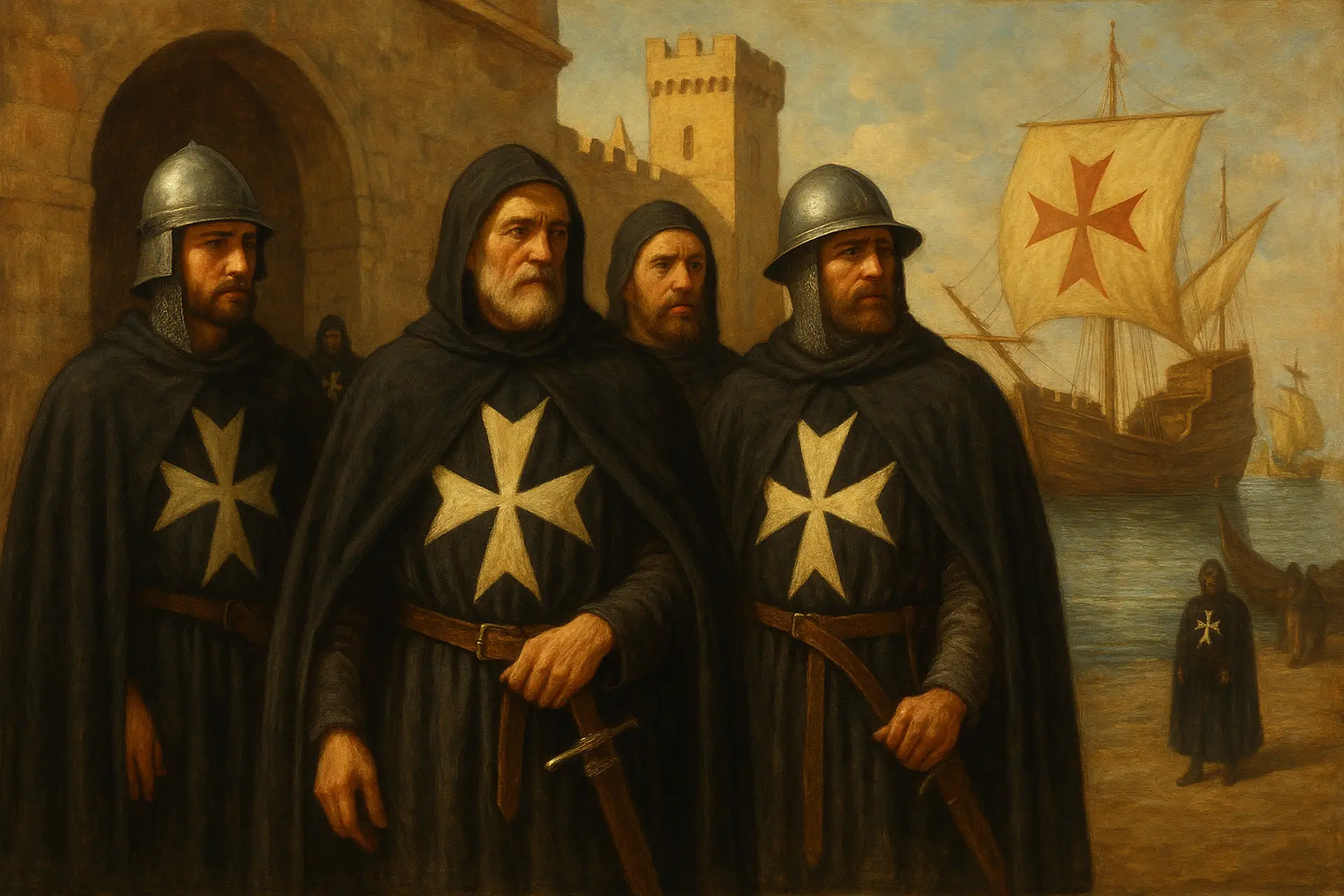
The community of the Hospitallers of St John has its origins in Jerusalem in the second half of the eleventh century.
Around 1048, according to historical tradition, merchants from the maritime Republic of Amalfi, the Ducatus Amalphiae or Ducatus Amalphitanus, obtained the Egyptian caliph’s permission to establish a church, a monastery and a hospice near the Church of the Holy Sepulchre, offering shelter and care to pilgrims visiting the Holy Places.
Under the spiritual influence of Benedictine monks, the foundation developed into a hospital serving pilgrims, the poor and the sick. Its work was associated with the Church of St John the Baptist, from whom the future community of St John would take its name.
These beginnings are essential to an understanding of the tradition. The Hospitallers first emerged as a community of faith, charity and service to their neighbour, rather than as a military force. Care for vulnerable people was central to their vocation. The sick and the poor were more than recipients of assistance; they were those to whom the brethren tending the hospital owed care, respect and devoted service.
Blessed Gerard And The Ordering Of The Community
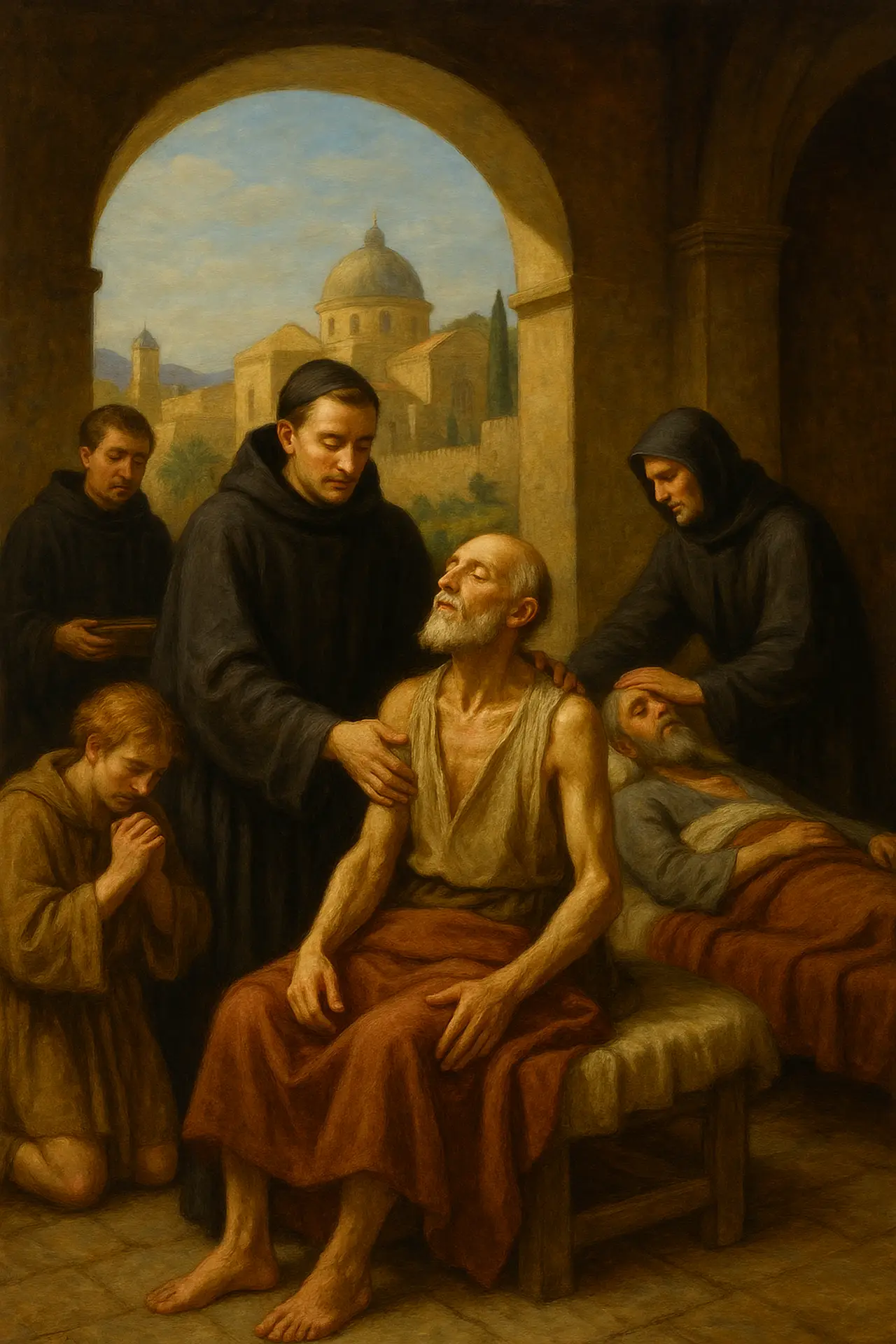
Following the capture of Jerusalem by the First Crusaders in 1099, the foundation entered a further phase of institutional development. Its head was Gerard, later known as Blessed Gerard, regarded as the founder and first Master of the Hospitallers of St John of Jerusalem. Under his guidance, the hospital gradually separated from its original Benedictine framework and became the centre of a distinct religious community.
Gerard organised the care of pilgrims, the sick and the poor, bringing together men prepared to dedicate their lives to faith and the service of those in need. Dependent houses were also established in Europe, demonstrating that, within its earliest decades, the community had already acquired an international character.
The Bull Of 1113 And The Recognition Of The Order
On 15 February 1113, Pope Paschal II issued Pie postulatio voluntatis, a papal bull fundamental to the Hospitallers’ legal constitution. It recognised Gerard’s community and placed it under the protection of the Holy See. The document confirmed the possessions and foundations administered by the community and granted it the right to elect its own head, free from interference by secular rulers or other local ecclesiastical authorities.
The bull did not create the Hospitaller community ex nihilo. It acknowledged an existing body and its autonomy. The distinction matters: the Order developed from a pre-existing foundation and subsequently received formal recognition under papal law.
After Blessed Gerard’s death in 1120, leadership passed to Raymond du Puy, who drew up the community’s first Rule. The brethren took the monastic vows of poverty, chastity and obedience, dedicating themselves to the care of the poor and the sick.
Amid the insecurity of the Holy Land, the community gradually assumed a military role as well. The protection of hospitals, pilgrims and the roads became inseparable from its Hospitaller vocation. The Knights of St John thus acquired a dual character, combining religious observance and charitable service with the armed protection of vulnerable people.
The Eight-Pointed Cross
The white eight-pointed cross became the Hospitallers’ distinctive emblem. They were also known as the Knights of St John, after the Order’s patron, St John the Baptist.
Its eight points came to be associated with the eight Beatitudes and, in later chivalric interpretations, with the virtues of those called to serve: Faith, Honour, Justice, Courage, Integrity, Loyalty, Compassion and Respect.
The cross signified more than membership of a military body. It expressed an ethical obligation through which the exercise of power remained subject to faith and the possession of rank was justified by service.
From Jerusalem To Acre And Cyprus
In 1187, Jerusalem fell to Sultan Saladin. The Knights of St John continued their work in other strongholds of the Holy Land, establishing their principal centre at Acre.
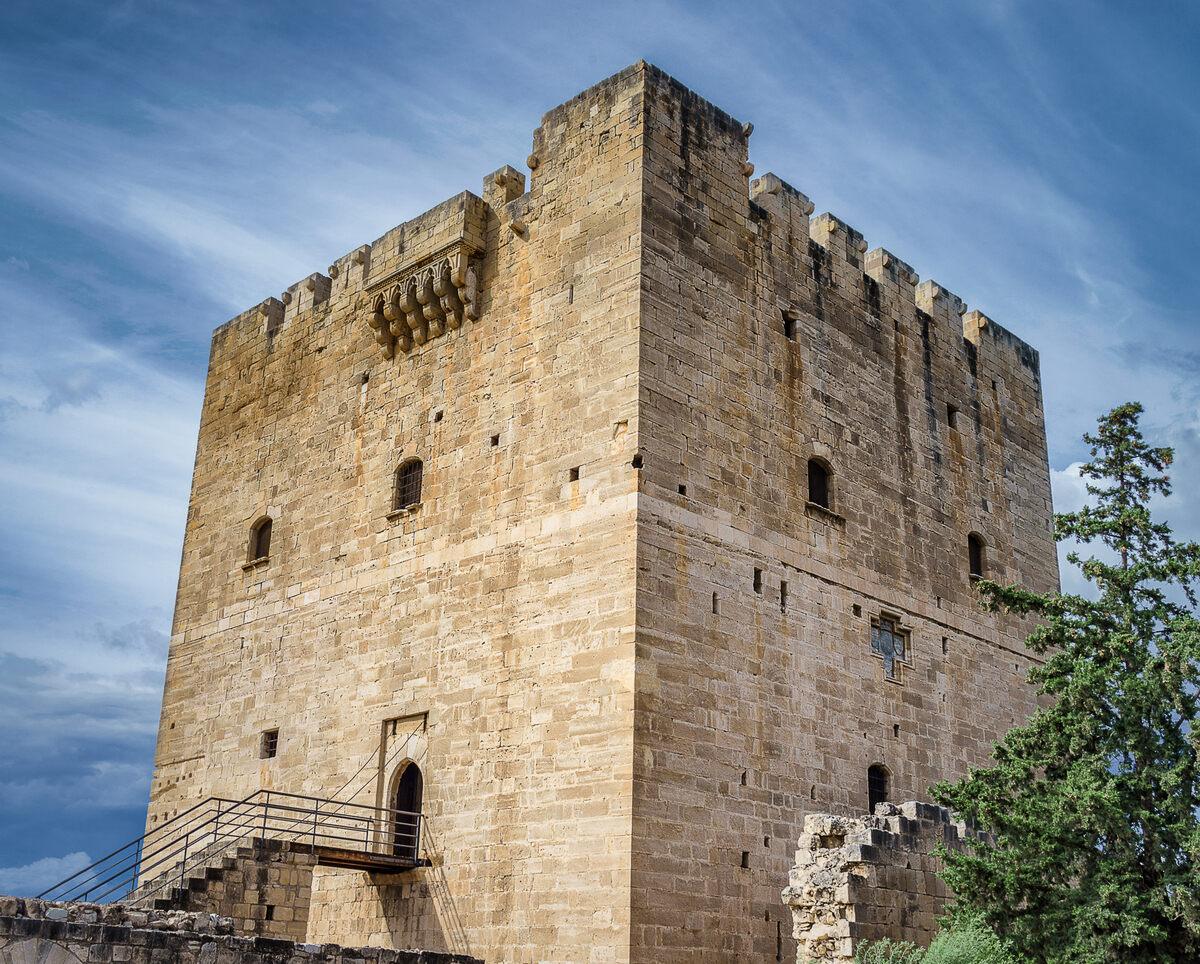
The fall of Acre in 1291 brought the major political presence of the crusading orders in the Holy Land to an end. The Hospitallers withdrew to Cyprus, establishing a headquarters and hospital at Limassol.
Cyprus’s strategic position prompted the Order to develop a fleet capable of protecting pilgrims and the sea routes of the eastern Mediterranean. This development of maritime activity provided the basis for its subsequent establishment on Rhodes.
Rhodes From 1310 To 1522
Under Grand Master Foulques de Villaret, the knights began the occupation of Rhodes in 1307. The undertaking was completed in 1310, when the Order transferred its headquarters to the island.
On Rhodes, the Order became a territorial and maritime power. The Grand Master governed with a Council; the Order maintained diplomatic relations, commanded land and naval forces, and struck its own coinage.
Knights from different regions of Europe were organised into bodies known as Langues. There were originally seven: Provence, Auvergne, France, Italy, Aragon, England and Germany. In 1462, Castile and Portugal separated from the Langue of Aragon to form a single eighth Langue, that of Castile and Portugal.
Each Langue maintained its own auberge, where the knights resided, dined together and conducted administrative and social affairs. Most stood along the Street of the Knights, Odos Ippoton. Each Langue also possessed its own priories and commanderies, with responsibilities for the Order’s defence and administration. The seat of command, principal fortress and residence of the Grand Master was the Palace of the Grand Master, or Kastello. This organisation reflected the Order’s European, multinational and aristocratic character.
In 1522, Rhodes was attacked by the forces of Sultan Suleiman the Magnificent. After almost six months of resistance, the knights were compelled to capitulate. Their adversary nevertheless recognised the courage of their resistance and permitted them to leave the island with the honours of war early in 1523.
Malta From 1530 To 1798
After leaving Rhodes early in 1523, the Order of St John was without a territory of its own. For almost eight years, Grand Master Philippe de Villiers de L’Isle-Adam and his knights sought a new territorial establishment from which to pursue their Hospitaller, military and diplomatic mission.
The Order’s requirements exceeded those of a religious community seeking accommodation. It required a territory with harbours, fortifications and sufficient autonomy to preserve its government, fleet, institutions, archives and international character.
During these years, the knights found temporary quarters in several parts of Europe. Pope Clement VII offered them hospitality at Viterbo, where they established a magisterial palace, a conventual church, a hospital and residences for the various Langues. An outbreak of plague in 1527, however, forced them to leave the city for Corneto and, subsequently, Nice.
Several possible territories were considered, among them Cerigo in the Morea, Elba, the harbour of Suda in Crete, Minorca, Ischia and Ponza. None offered the necessary combination of military security, suitable harbours, political autonomy and a sufficiently commanding strategic position.
The eventual settlement resulted from the intervention of Emperor Charles V of Habsburg, one of the most powerful sovereigns of the period.
Emperor Charles V And His Empire


Charles V, known in Spain as Charles I, was born at Ghent, in Flanders, in 1500. His dynastic position combined the inheritances of Habsburg, Burgundy, Castile and Aragon. He was King of Spain, Naples and Sicily, sovereign of the Netherlands, Archduke of Austria and Holy Roman Emperor. Historians also refer to the polity he headed as the Holy Roman Empire of the German Nation, a description indicating the prominence of its German territories and principalities, rather than the Emperor’s personal ethnicity. Charles cannot simply be described as an ethnically German sovereign. Born and brought up in the Burgundian and Netherlandish world, he inherited and ruled kingdoms and territories inhabited by many peoples. The extent of his European and overseas possessions led later generations to describe his dominions as an empire ‘on which the sun never set’.
Charles believed himself charged with defending the political and religious unity of Western Christendom. His reign was nevertheless characterised by several conflicts: rivalry with Francis I of France, the Reformation set in motion by Martin Luther, tensions with the Papacy and the expansion of the Ottoman Empire under Suleiman the Magnificent.
The Ottomans took Belgrade in 1521. Their victory at Mohács in 1526 substantially weakened the Kingdom of Hungary, and in 1529 the Sultan’s armies reached the gates of Vienna. Meanwhile, Ottoman fleets and North African corsairs threatened Mediterranean coasts and trading routes. In these circumstances, establishing the Knights of St John at a strategic point in the central Mediterranean served both the Order’s interests and Charles V’s military policy.
Emperor Charles V’s Authority Over Malta
Charles V granted Malta to the Order in his capacity as King of Sicily, rather than as Holy Roman Emperor. In law, Malta, Gozo and Comino formed part of the dominions of the Sicilian Crown. His authority over the archipelago therefore derived from his Sicilian kingship, not his imperial dignity.
The instrument of 1530 was issued by Charles V together with his mother, Queen Joanna of Castile, as sovereigns of the Sicilian possessions. This legal relationship explains why the Order’s annual tribute was to be presented to the Viceroy of Sicily, the Crown’s representative in the kingdom, rather than to an imperial authority in the German lands.
The transfer was supported and approved by Pope Clement VII, who had interceded for the knights and sought to establish the Order in a territory from which it could continue the defence of the Mediterranean.
Why Malta Was Chosen
The choice of Malta was governed principally by strategy. The archipelago lies in the central Mediterranean, south of Sicily, between the shores of Europe and North Africa. From this position, it was possible to watch over the sea routes between the eastern and western Mediterranean, between Italy and Africa, and between Ottoman bases and territories under Spanish authority.
For Charles V, the knights’ establishment on Malta created an outpost capable of protecting Sicily, southern Italy and the maritime routes of his dominions. The knights could also check the activities of North African corsairs and the naval advance of the Ottoman Empire.
Defending Malta imposed a considerable burden on the Sicilian Crown. Corsairs had repeatedly attacked the island, and the viceroys had to commit substantial resources to its garrisons and fortifications. Entrusting the archipelago to the Order transferred much of that responsibility to an institution experienced in both land and maritime warfare.
For the Order, Malta’s chief advantage lay in its natural harbours. Grand Harbour and Marsamxett could shelter its fleet and provide the foundation of a renewed maritime power. The archipelago’s position allowed the knights to continue protecting Christian shipping, although their new territory was smaller, poorer and less fertile than Rhodes.
The Knights’ Reservations
Charles V’s offer was not immediately accepted. Proposals had first been made as early as 1524, but the knights considered Malta inferior to Rhodes. They still hoped to return to their former island and were reluctant to relinquish the prospect of recovering it.
In December 1525, the Council sent a commission of eight members to examine Malta, Gozo and Tripoli. Its report was unfavourable. Malta was described as a predominantly limestone island, with poor soil, no rivers and inadequate supplies of water. Local food production fell short of the archipelago’s needs, making imports of grain and other provisions from Sicily indispensable.
The capital, Mdina, stood inland, far from the sea, whereas the Order’s work depended upon direct access to the harbours. Existing fortifications were inadequate, and both Malta and Gozo were exposed to a major assault.
Gozo was more fertile but less well defended. Tripoli, on the North African coast, possessed dilapidated fortifications and would require considerable military resources. The commission considered the simultaneous defence of Malta and Tripoli a difficult undertaking.
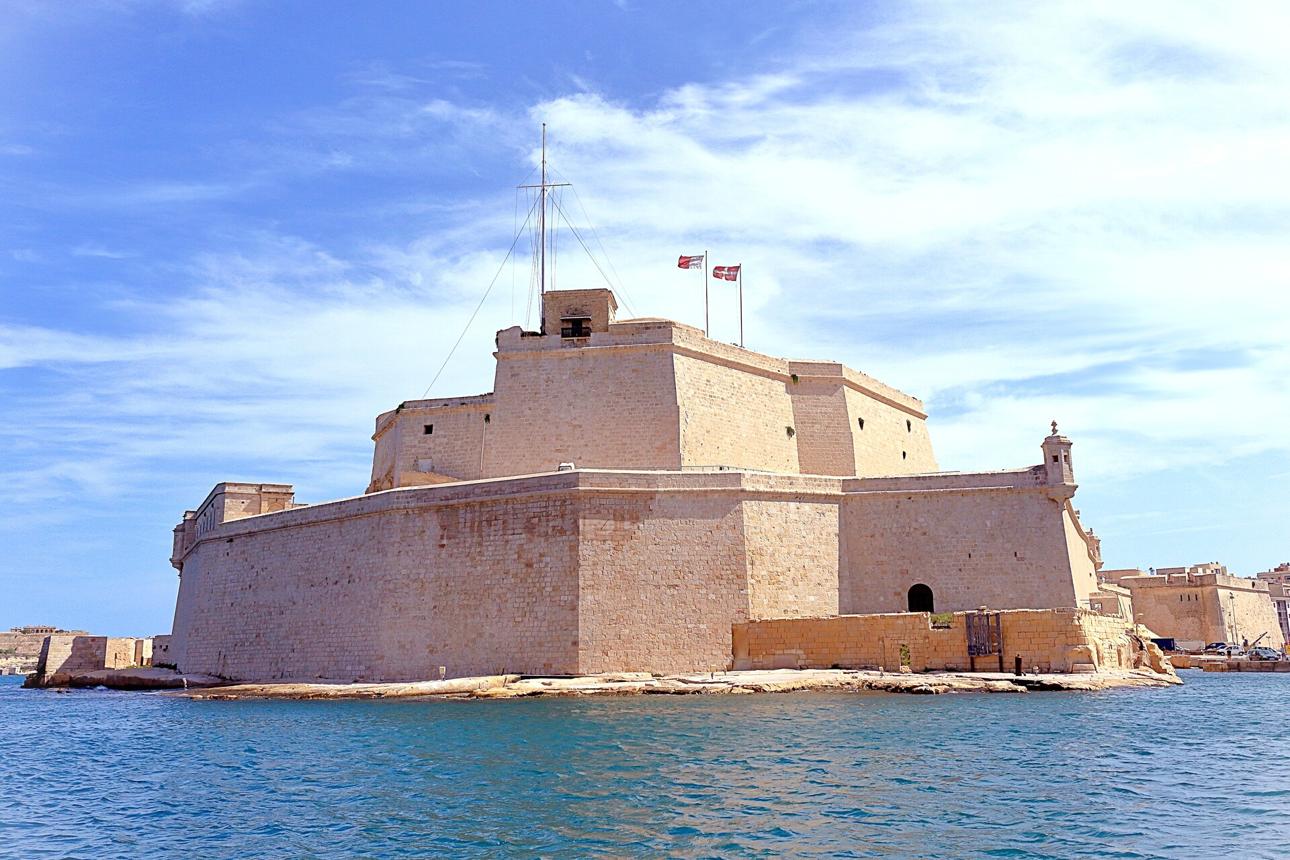
It nevertheless recognised two outstanding advantages: the exceptional harbours, and the possibility of developing Fort St Angelo and the small town of Birgu into a naval, military and administrative centre.
The knights also objected to the original political conditions. They sought to avoid becoming vassals of the Spanish Crown or surrendering the Order’s traditional neutrality. The obligation to defend Tripoli was considered onerous, while restrictions on access to Maltese harbours by vessels belonging to states at war with Spain were incompatible with the Order’s international character.
After several years of negotiation, Pope Clement VII intervened to secure more favourable terms. The prolonged displacement nevertheless increased the difficulties confronting the knights. Without a settled territory, an administrative centre and a naval base, the Order faced a substantial risk of fragmentation and loss of institutional cohesion.
The Grant Of 1530
At Castelfranco, Charles V signed the instrument granting the Order the islands of Malta, Gozo and Comino, together with the city and fortress of Tripoli. The document is dated 23 March 1530, less than a month after his solemn coronation as Emperor by Pope Clement VII at Bologna on 24 February.
Grand Master Philippe de Villiers de L’Isle-Adam and the Council accepted the terms on 25 April 1530. The territories were neither sold to the Order nor bestowed as private property. They were granted as a free and perpetual fief under the nominal suzerainty of the Sicilian Crown. This arrangement permitted the Order to hold and administer them indefinitely, provided it observed the conditions of the grant. Malta could not, however, be sold, ceded or transferred at will to another power.
The Order enjoyed extensive internal autonomy. It retained its government, institutions, laws, courts, military organisation and right to strike coinage. Its relationship with the Sicilian sovereign was predominantly legal and ceremonial.
The grant thus established a negotiated balance: Charles V preserved the archipelago’s nominal connection with the Kingdom of Sicily, while the Order acquired the autonomy required to govern and defend it.
The Conditions Of The Grant
The grant carried a number of obligations. The Order was to defend Malta, Gozo and Tripoli and prevent their use against the Kingdom of Sicily. The territories could not be alienated or transferred to another power. The inhabitants of Malta and Gozo were to retain their ancient laws, customs, rights and privileges. The islands would continue receiving grain from Sicily exempt from certain duties, since local production could not feed the entire population. The Order was not to shelter fugitives from Sicilian justice, and was to maintain peace towards the Crown’s possessions. The best-known obligation, however, was the tribute of the Maltese falcon.
There were also provisions concerning the island’s ecclesiastical government. The Grand Master could propose three candidates for the bishopric of Malta, one of whom had to be a subject of the Sicilian Crown. The bishop was also to hold an important place within the Order’s organisation.
Whenever the office of Grand Master fell vacant, the investiture of his successor was to be renewed in accordance with the legal forms of the period.
The Maltese Falcon
Each year, on All Saints’ Day, 1 November, the Grand Master was required to present a hunting falcon to the Viceroy of Sicily, in symbolic acknowledgement of the bond between the Order and the Sicilian Crown. The falcon was not the islands’ economic price. The grant cannot therefore be characterised in law as the purchase of Malta in exchange for a falcon. The bird constituted a tribute of investiture, acknowledging the legal origin of the Order’s tenure.
In European aristocratic culture, the falcon was a gift of considerable distinction. Falconry belonged to the world of royal courts, nobility, discipline and martial accomplishment. A well-chosen, well-trained bird could be highly valuable, a gift appropriate to a sovereign recipient. It had to be healthy and suitable for hunting. Prepared by the Order’s falconers, it was conveyed to Sicily with an official letter from the Grand Master. Its ceremonial presentation to the Viceroy symbolically renewed the relationship established in 1530. The term ‘Maltese falcon’ did not necessarily denote a separate species native exclusively to Malta. In the documents and traditions of the period, it described a bird of prey selected and trained for falconry, associated with the tribute owed for possession of the archipelago.
The grant is traditionally understood to have required a single falcon annually. Research into subsequent correspondence from Grand Masters to the viceroys and kings of Sicily nevertheless indicates that, at certain periods, ceremonial practice included the dispatch of several falcons. This variation does not alter the obligation’s legal significance: the tribute was symbolic, not commercial.
Much later, ‘the Maltese falcon’ acquired a wider cultural association through Dashiell Hammett’s novel of 1930 and the well-known 1941 film starring Humphrey Bogart. The jewelled golden falcon of fiction was an invention. The historical tribute was a living bird trained for hunting, not a statuette.
The Knights’ Arrival In Malta
The Grand Master and the main body of the Order reached Malta on 26 October 1530. They travelled aboard the galleys Santa Croce, San Filippo and San Giovanni, the great ships Santa Maria and Sant’Anna, and other transport vessels. L’Isle-Adam established his residence at Fort St Angelo, beside the small town of Birgu. The knights and the Order’s personnel settled around Grand Harbour.
The Church of St Lawrence in Birgu became the Order’s first conventual church on Malta. Following a service of thanksgiving, the Grand Master made his solemn entry into the ancient capital, Mdina, on 13 November 1530, receiving the city’s keys in a symbolic ceremony. The Malta the knights encountered had not yet acquired the extensive fortifications familiar today. The fortifications of Mdina, Gozo and St Angelo were insufficient against modern siege techniques. The harbours were of considerable strategic value, but their defence required substantial investment.
The Order began strengthening the fortifications, reorganising the harbours, developing its fleet and gradually drawing the centre of economic and administrative life towards Grand Harbour.
The arrival of the Knights of St John initiated a new phase in the archipelago’s history. Malta gradually passed from medieval structures into the political, military and urban order of the early modern age. For Charles V, the island became an outpost in the defence of the central Mediterranean. For the Order, it became a new fortress, a renewed seat of power and the territory with which the knights’ name would become permanently associated.
From 1530 onwards, the Hospitallers of St John, formerly known as the Knights of Rhodes, became historically established under the designation Knights of Malta.
The Great Siege Of Malta In 1565
The Great Siege of Malta in 1565 was a decisive episode in the conflict between the Ottoman Empire and the Christian powers for predominance in the Mediterranean. The resistance of the Knights of St John, troops arriving from Sicily and the Maltese people made the island a European symbol of courage, sacrifice and the defence of the faith.
The siege’s importance extended beyond the immediate military engagement. Malta held a crucial position between Sicily and the North African coast. Possession of the island afforded control of the sea routes between the eastern and western Mediterranean and could facilitate operations against Sicily, southern Italy and the Spanish dominions.
For the Ottoman Empire, taking Malta would remove one of the principal Christian naval bases in the central Mediterranean. For the Order of St John, losing it might mean a renewed displacement comparable to the exile that followed the fall of Rhodes, and perhaps the end of its existence as a territorial and military power.
Since settling on Malta in 1530, the Order had developed its fleet and continued to attack Ottoman and North African vessels, intercept maritime traffic and free Christian captives. Its galleys posed a constant threat to Ottoman sea communications. The knights’ resistance on Rhodes in 1522 also remained relevant to Suleiman the Magnificent’s assessment of the Order. Although he had then allowed them to depart with the honours of war, their renewed naval strength on Malta had re-established them as substantial military opponents. Attacks on Ottoman and North African shipping, and the loss of valuable vessels and cargoes, contributed to his decision to eliminate the Order’s central Mediterranean base permanently. The expedition of 1565 therefore sought more than the capture of an island. It was intended to destroy the Knights of St John’s military power, open the way towards Sicily and consolidate Ottoman ascendancy over the Mediterranean.
Malta’s defence was led by Grand Master Jean Parisot de Valette, a veteran of the Mediterranean wars who had himself been a prisoner aboard a North African galley. About seventy years of age, he understood his opponents’ strategies, spoke Turkish and possessed practical experience of naval warfare. He directed the defence from among its defenders, continually inspecting fortifications, organising reserves and taking a personal part at critical moments. His moral authority, insistence upon discipline and refusal to contemplate surrender were indispensable to the island’s resistance.
The Ottoman land forces were commanded by Lala Mustafa Pasha, while the fleet was under Piyale Pasha, one of the Empire’s leading admirals. They were subsequently joined by the established naval commander and corsair Turgut Reis, known in the West as Dragut, the Ottoman governor of Tripoli, which he had captured in fighting against the Knights of Malta. One of the most experienced naval strategists of his age, he died during the siege.
The Great Siege thwarted the Ottoman attempt to remove the Order of St John from the central Mediterranean. Holding Malta protected the routes linking Sicily, Italy, Spain and the western Mediterranean, and prevented the island’s transformation into an Ottoman naval base. News of the victory prompted public celebrations across Europe. After decades of Ottoman expansion, Malta’s defence was seen as a triumph for Christendom as a whole. Jean Parisot de Valette became a military figure of considerable contemporary reputation, while the Knights of St John and the Maltese people acquired considerable prestige.
The victory of 1565 also helped create the political and moral climate in which the Holy League would take shape. Six years later, at Lepanto, the Knights of Malta would again confront the Ottoman fleet, this time as part of a substantial European naval coalition.
The siege had exposed the vulnerability of the Sciberras peninsula, from whose heights Ottoman artillery had bombarded the Order’s defences. To prevent a recurrence, a new fortified city was planned. On 28 March 1566, Grand Master Jean Parisot de Valette laid its foundation stone. The city was named Valletta in his honour.
The Battle Of Lepanto


On 7 October 1571, in the Gulf of Patras, near Naupaktos, known in the West as Lepanto, a naval engagement of major significance for the early modern period took place. Its significance extended beyond the immediate encounter between two fleets and encompassed the conflict for command of the Mediterranean between the Ottoman Empire and the Christian states united in the Holy League. Formed at the initiative of Pope Pius V, the coalition comprised the Spanish Monarchy, including its possessions in Naples and Sicily, the Republic of Venice, the Papal States, the Republic of Genoa, the Duchy of Savoy, the Grand Duchy of Tuscany and the Order of St John of Jerusalem, established on Malta. Supreme command was entrusted to Don John of Austria, the natural son of Emperor Charles V and half-brother of Philip II of Spain.
The battle’s importance must be understood on several levels. First, Lepanto undermined the prevailing perception of Ottoman naval invincibility. The Empire’s sustained advance had encouraged the perception that its power could not be checked. Malta’s resistance in 1565 had already challenged that perception; Lepanto further discredited it through a decisive naval defeat.
Secondly, the victory prevented the Mediterranean from becoming a sea in which Ottoman naval supremacy went unchallenged. It protected, for a time at least, Italy, Malta, Sicily, the Spanish possessions and the trading routes of the central and western Mediterranean. The battle reinforced the strategic division between an eastern Mediterranean in which the Ottoman Empire remained dominant and central and western waters defended by the Christian powers.
Thirdly, Lepanto demonstrated the strength of a European coalition capable of setting aside, however briefly, the rivalries of Venice, Spain, the Papacy, Genoa and the other participating states. Cooperation was not without its strains, but the victory showed that common action could check Ottoman expansion.
Fourthly, the engagement revealed a change in the conduct of warfare at sea. The traditional galley had not disappeared, but heavy artillery, small arms and disciplined infantry had become decisive. The Venetian galleasses demonstrated the power of ships equipped as artillery platforms, foreshadowing the gradual emergence of naval warfare dominated by cannon and high-sided vessels.
The victory immediately acquired substantial religious significance. Pope Pius V attributed it to divine protection and the prayers offered throughout the Catholic world. The feast first instituted as Our Lady of Victory subsequently became that of Our Lady of the Rosary, celebrated on 7 October.
The battle was soon represented in European painting, literature, music and commemorative practice. Among those who fought was Miguel de Cervantes, the future author of Don Quixote. Serving aboard the galley Marquesa, he was wounded and largely lost the use of his left hand. He regarded Lepanto as an experience of exceptional importance and honour in his life.
For the Order of St John, Lepanto provided a symbolic counterpart to its defensive victory in the Great Siege. In 1565, the knights had defended an island; in 1571, they helped defend the Mediterranean balance of power.
Lepanto thus remained a major event within the historical tradition of St John, a moment in which the defence of the faith, chivalric discipline, solidarity between peoples and personal sacrifice met in a decisive encounter. Its broader significance cannot be assessed solely through the number of vessels captured or the territories defended. Lepanto showed that a power thought invincible could be halted through the coordinated application of courage, preparation and collective determination. For the Knights of Malta, this lesson entered their historical identity: victory depends less on the avoidance of danger than on sustained resistance in the face of it.
The Reformation And The Emergence Of The Protestant Traditions Of St John
The Protestant Reformation of the sixteenth century profoundly altered Europe’s religious and institutional landscape. It inevitably affected the Order of St John, whose priories, commanderies and estates extended across numerous European kingdoms and principalities.
In territories that remained Catholic, the Order’s establishments continued to acknowledge the authority of its leadership, based successively on Rhodes and Malta. In states that embraced the Reformation, monasteries and religious property were often confiscated, secularised or transferred to the Crown, while the Order’s communities were dissolved or reorganised to reflect the new confessional settlement.
The process did not follow the same course everywhere. In England and Sweden, the Order’s medieval establishments were suppressed. In the German lands, however, the Bailiwick of Brandenburg survived as a distinct chivalric institution and became the principal centre of the Protestant tradition of St John.
The Reformation did not, therefore, bring four independent Protestant orders into being at once. It first established a German Lutheran line of continuity, from which the independent orders of the Netherlands and Sweden emerged much later. The British Order followed a separate modern course, taking its present institutional form in the nineteenth century.
The Bailiwick Of Brandenburg And The German Lutheran Continuity
In the Middle Ages, the Order of St John’s German possessions were organised within the Grand Priory of Germany. Within it developed the Bailiwick of Brandenburg, known in German as the Balley Brandenburg des Ritterlichen Ordens Sankt Johannis vom Spital zu Jerusalem.
The Bailiwick had already acquired considerable administrative autonomy in the medieval period. Under the agreement concluded at Heimbach in 1382, its relationship with the Order’s German leadership was regulated so that the Brandenburg knights could elect their own head, the Herrenmeister, whose election was then to be confirmed through the Order’s established arrangements.
In the sixteenth century, most of the Brandenburg knights adopted the Lutheran faith. The Bailiwick neither disappeared nor became wholly absorbed into secular government. It continued as a Lutheran chivalric institution under the protection of the House of Hohenzollern.
A change of confession did not mean the abandonment of its identity as an institution of St John. The knights retained the name of St John, the eight-pointed cross and the ideal of service to the sick and vulnerable. Relations with the Catholic Order on Malta became more difficult, but they were not immediately and irrevocably severed. At certain periods, administrative, diplomatic and property relations continued between the two bodies.
During the Napoleonic upheavals and the reforms of the Prussian state, the Bailiwick was secularised and, in 1812, transformed into an order of merit of the Prussian Crown. Its surviving knights and institutional tradition nevertheless made restoration possible.
In 1852, Frederick William IV of Prussia reconstituted the Bailiwick of Brandenburg as a chivalric order. The restored institution resumed its charitable vocation of medical care and social service.
From the latter half of the nineteenth century, the Johanniterorden developed hospitals, nursing services, medical units and philanthropic undertakings. Its members served as volunteers and medical personnel, including during armed conflict.
In contemporary Germany, the Bailiwick is legally recognised and continues as a Lutheran chivalric order. Its mission is supported by an extensive network of institutions and humanitarian organisations bearing the Johanniter name, active in emergency medicine, patient transport, civil protection, care of the elderly, social welfare and international relief.
The German Order also includes commanderies abroad. These operate, among other countries, in Finland, France, Switzerland and Hungary, maintaining their institutional connection with the Bailiwick of Brandenburg.
The Order Of St John In The Netherlands
In the Netherlands, the Reformation brought the dissolution or secularisation of the Order’s old Catholic establishments. The modern tradition of St John was reconstituted through its connection with the Bailiwick of Brandenburg.
During the nineteenth century, members of the Dutch nobility were admitted to the German Order. Prince Hendrik, husband of Queen Wilhelmina and a knight of the Bailiwick, supported the creation of a national body.
On 30 April 1909, to mark the birth of Princess Juliana, the Dutch Commandery of the Bailiwick of Brandenburg was founded. It received recognition by royal decree on 31 July that year.
After the Second World War, the Dutch body became independent. A royal decree of 5 March 1946 constituted it as an Order of St John; since 1958, its official name has been Johanniter Orde in Nederland.
The Order has a Protestant Christian foundation and historic ties to the Dutch Crown and nobility. Its contemporary work supports people who are ill, elderly, disabled, homeless or otherwise vulnerable.
Through its foundations and volunteers, it provides care, accessible transport, social projects and programmes for those inadequately served by ordinary public provision. In 2002, the Chancellery of the Netherlands Orders included the Johanniter Orde in Nederland among the chivalric orders recognised in the Kingdom of the Netherlands.
The Order Of St John In Sweden
The tradition of St John had been present in Sweden since the Middle Ages. Towards the end of the twelfth century, the Order founded a house near the site of present-day Eskilstuna, alongside other establishments caring for the sick, the elderly and travellers.
The Swedish Reformation of the sixteenth century brought the confiscation of monasteries and ecclesiastical property, and the disappearance of the Order’s medieval organisation.
The modern line was revived in the twentieth century, again through the Bailiwick of Brandenburg. A Swedish Association of Knights of St John was formed in 1920, initially within the German Order.
After the Second World War, the Swedish body separated from the Bailiwick. Its statutes were approved by King Gustaf V in 1946, and Johanniterorden i Sverige became an independent order.
Founded upon Christian and chivalric principles, the Swedish Order stands under the High Protection of the King of Sweden. Its work encompasses support for vulnerable people, grants for charitable projects, voluntary service by its members, and assistance to social and medical institutions.
The British Order Of St John
The development of the British Order followed a different course from that of Brandenburg. The ancient Priory of England, established in the twelfth century, was dissolved under Henry VIII during the separation of the Church of England from Rome.
Briefly restored under Mary I, the Priory was suppressed once more under Elizabeth I. The relationship between the medieval body and the modern British institution therefore lacks the same unbroken administrative continuity found in the Brandenburg tradition.
In the first half of the nineteenth century, efforts were made to re-establish a body of St John in the United Kingdom. The organisation that emerged was not initially recognised by the Order’s Catholic leadership, but gradually established its own standing through medical and philanthropic service.
Britain’s rapid industrialisation had brought widespread accidents in factories, mines, docks and on the railways, without adequate public provision for first aid. The organisation of St John responded to this need by training the public and establishing voluntary services.
The St John Ambulance Association was founded in 1877 to teach first aid. The St John Ambulance Brigade followed in 1887, bringing together volunteers able to provide medical assistance at public events and in emergencies.
In 1882, the British organisation founded an ophthalmic hospital in Jerusalem. It continued the tradition of caring for the sick close to the places where the medieval Hospitaller community had first taken root, offering treatment without distinction of religion, ethnicity or financial means.
On 14 May 1888, Queen Victoria granted the organisation a Royal Charter, constituting it as an order of chivalry of the British Crown. Its present name is The Most Venerable Order of the Hospital of St John of Jerusalem.
Unlike the continental Protestant orders, the British Order is not today confined to a single denomination. It is a Christian order of the British Crown, with an international and inclusive membership and humanitarian vocation.
The British monarch is the Sovereign Head of the Order, a dignity presently held by King Charles III. The Order extends across numerous Commonwealth countries and beyond. Its best-known works are the St John Ambulance network and the St John of Jerusalem Eye Hospital Group.
Through these institutions, the Order provides first-aid training, ambulance services, medical assistance, disaster relief and ophthalmic treatment. It now represents the most extensive international network among the four institutions united in the Alliance.
The Formation Of The Alliance Of The Orders Of St John
Following the independence of the Dutch and Swedish orders, four chivalric institutions arising from the Protestant or Reformed traditions of St John existed in Europe:
- the Bailiwick of Brandenburg of the Order of St John;
- The Most Venerable Order of the Hospital of St John of Jerusalem;
- Johanniter Orde in Nederland;
- Johanniterorden i Sverige.
To strengthen cooperation, their representatives signed the Convention of the Alliance of the Orders of Chivalry of the Hospital of Saint John of Jerusalem at Nieder-Weisel, Germany, on 13 June 1961.
Nieder-Weisel is the spiritual centre of the Bailiwick of Brandenburg. The choice had historical significance: the German tradition had provided the institutional foundation from which the Dutch and Swedish orders developed, and one of the principal means by which the identity of St John survived in the Protestant world.
The Alliance is not itself a separate chivalric order. It has no common Grand Master and does not extinguish its members’ autonomy. It is a federation of independent orders, each with its own statutes, leadership, admission arrangements and legal status in its country of establishment.
Its principal purposes are:
- to preserve their shared Christian and Hospitaller tradition;
- to strengthen the international standing of the member orders;
- to express a common position on matters of mutual concern;
- to cooperate in medical, social and humanitarian work;
- to protect the name, cross and symbols of St John;
- to distinguish the member orders from organisations they do not recognise;
- to develop relations with the Catholic institution represented by the Sovereign Military Order of Malta.
The Alliance comprises only these four orders. The Sovereign Military Order of Malta, or SMOM, is not a member, although it works closely with it. This distinction explains two different expressions:
- ‘the four orders of the Alliance’ denotes the German, British, Dutch and Swedish orders;
- ‘the five Orders of St John’ denotes those four together with the Sovereign Military Order of Malta.
The five institutions affirm their common spiritual origins in the Hospitaller community founded at Jerusalem and their vocation to serve the sick and the poor. They cooperate in charitable, medical and spiritual undertakings while preserving their confessional identities and legal independence.
In practical terms, this institutional family coordinates humanitarian work through ambulance services, hospitals, medical centres, care homes, rescue services, first-aid programmes, support for people with disabilities and disaster response.
Modern cooperation also has an ecumenical dimension. Catholic, Anglican and Protestant representatives join in prayer and ceremony, reaffirming the Christian vocation of service to humanity. In 2024, the five orders adopted a common prayer recalling their shared beginnings, commitment to Christian chivalry and duty to care for the poor and the sick.
The Meaning And Limits Of Mutual Recognition
The Alliance’s formation brought closer together institutions that had developed for centuries within differing political and confessional settings. It provided a shared inheritance with a defined framework for international cooperation.
The Alliance is not, however, a public international body, a universal ecclesiastical authority or a historical tribunal empowered to issue binding judgements upon every organisation claiming a connection with the tradition of St John.
Recognition between the four Alliance orders and the Sovereign Military Order of Malta is a matter of reciprocal institutional recognition. It expresses the agreement of these five organisations concerning their own legitimacy and the criteria upon which they choose to cooperate.
That recognition carries considerable political, legal and symbolic weight for those within the arrangement. It cannot automatically be treated as a universal verdict upon the historical tradition of St John as a whole.
No Orthodox authority or institution descending from the tradition of the Russian Grand Priory participated in establishing this framework of recognition. Their absence does not demonstrate that the Russian chapter, Orthodox participation or the lines developed in the diaspora lack historical substance. It indicates that these traditions were not included in the institutional framework established by the Western Protestant orders and the Roman Catholic body in the twentieth century.
Three distinct matters must therefore be kept in view:
- the historical continuity of a tradition;
- legal recognition granted by a state;
- mutual recognition agreed between particular organisations.
The four Alliance orders are established chivalric institutions, protected or recognised within their respective national systems and engaged in substantial humanitarian work. Their cooperation with the Sovereign Military Order of Malta is one of the most important contemporary expressions of the heritage of St John.
The group of five nevertheless constitutes a modern system of mutual recognition, rather than the whole history of the Order or the entirety of the traditions that have sustained its ideal through the centuries.
The Crisis Of 1798
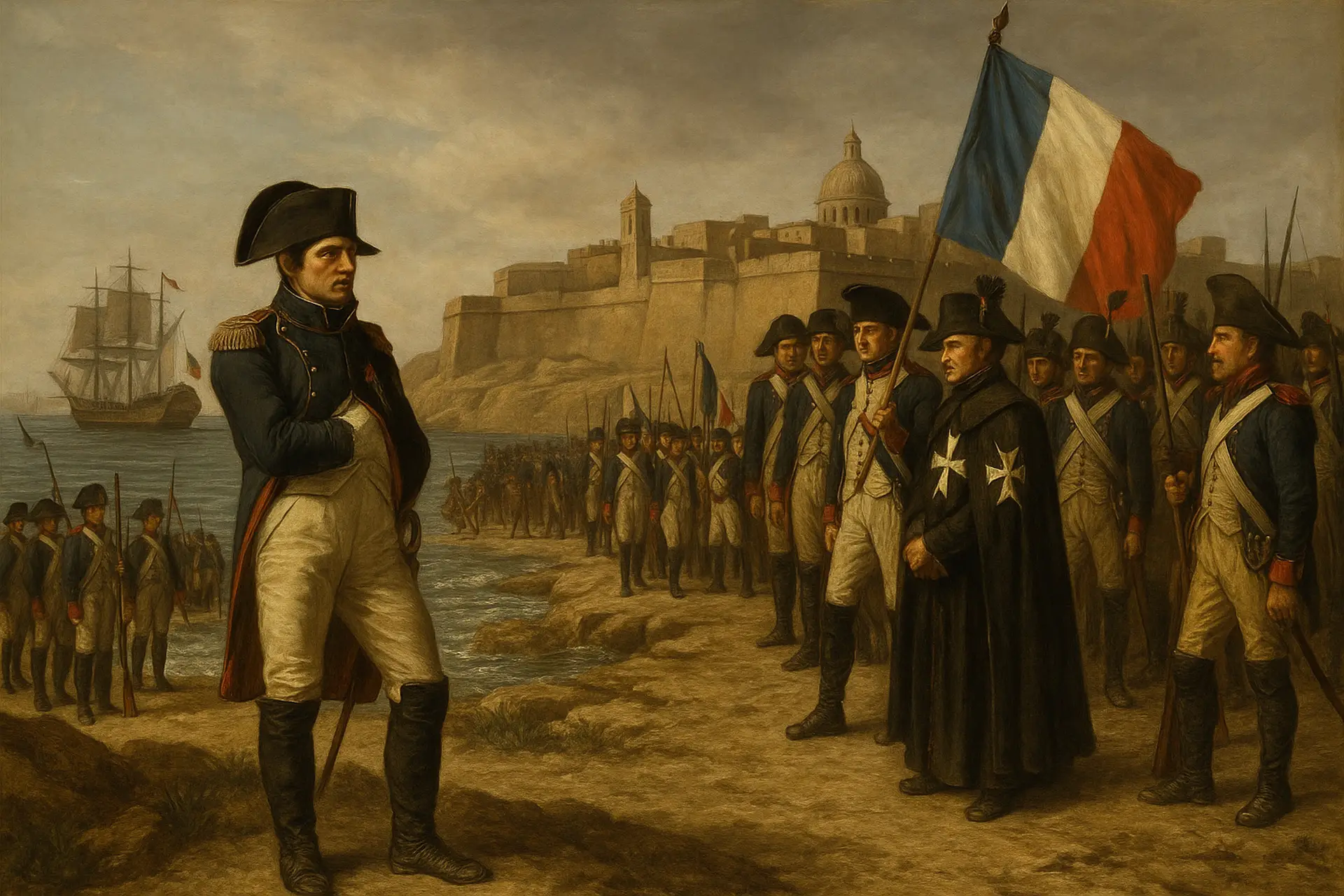
In June 1798, during his expedition to Egypt, Napoleon Bonaparte occupied Malta. The Order was already in considerable difficulty. The French Revolution had confiscated much of its property and income in France, and many of its knights were themselves French. The Order’s rules also forbade taking up arms against fellow Christians.
Grand Master Ferdinand von Hompesch capitulated, and the knights were compelled to leave. The Order lost the territory it had governed for 268 years, its administrative centre, naval base and a considerable part of its resources.
The Treaty of Amiens of 1802 provided for Malta’s restoration to the Order, but that provision was never implemented.
The loss of Malta was more than a change of location. It was a rupture that permanently altered the Order’s structure and created the circumstances in which several institutional lines of continuity would emerge.
Paul I Of Russia And The Preservation Of The Order
During this crisis, the Russian Empire provided assistance of decisive importance. Relations between Russia and the Order of St John predated 1798. Under Catherine II, Russian officers had trained alongside the Maltese knights, and diplomatic and military contacts were already established.
After his accession, Tsar Paul I developed a substantial interest in the tradition of St John. In 1797, he was designated Protector of the Order and supported the reorganisation of its property and establishments within the Russian Empire.
Following the occupation of Malta, many knights sought refuge in St Petersburg. Those assembled in Russia proclaimed Paul I Grand Master on 27 October 1798. He accepted the dignity on 13 November and, on 29 November, incorporated the Order of Malta into the system of chivalric orders of the Russian Empire.
Paul publicly bore the title and insignia of Grand Master. The Maltese cross and magisterial crown entered imperial heraldry and ceremonial. Under his authority, a Catholic Grand Priory and a Russian Grand Priory were organised, the latter also admitting Orthodox members. For the first time, a substantial Orthodox institution participated directly in the leadership and continuity of the tradition of St John. The election of a married Orthodox sovereign to head an historically Catholic institution did not satisfy all the earlier canonical requirements. That irregularity does not, however, negate the historical fact of his leadership.
Paul I was elected by a substantial body of knights, accepted the dignity, exercised actual government, was recognised by the establishments in St Petersburg and placed the authority, resources and protection of the Russian Empire at the Order’s disposal.
His intervention prevented the Order’s complete disintegration after the loss of its territory and political centre. From this perspective, Orthodox Russia was not a peripheral element in this history but one of the forces that preserved the Order’s institutional and symbolic continuity after 1798.
Paul I And The Holy See
Relations between Paul I and the Holy See were more complex than a simple opposition between ‘full recognition’ and ‘non-recognition’ would suggest. Electing a married Orthodox sovereign, who had not taken monastic vows, to lead a Catholic religious order raised obvious canonical difficulties. Yet Rome could not disregard the political and institutional circumstances created by the loss of Malta.
Sustained diplomatic correspondence passed between the Imperial Court at St Petersburg and the Holy See through papal representatives, Russian diplomats and senior dignitaries of the Order. It addressed the knights’ protection, the Order’s reorganisation in Russia, the position of the Grand Priory, the administration of its property and the possibility of regularising the new leadership. This correspondence, the continuing negotiations and the relations maintained with the Russian Emperor show that Rome treated him as the Order’s indispensable protector and the de facto head of the institution that had secured its survival after the crisis of 1798.
Recognition was thus implicit, diplomatic and functional. The Holy See did not fully regularise, by a solemn instrument, the canonical position of a married Orthodox Grand Master, but accepted the reality of Paul’s government and negotiated with him over the Order’s future.
Russia’s role cannot be reduced to the initiative of an isolated group of knights taking refuge in St Petersburg. Paul placed at the Order’s disposal the authority of the Imperial Crown, financial resources, diplomatic protection, premises, administrative structures and a new centre of government. Both the Catholic and Russian Grand Priories operated under his authority, and the Order’s insignia became part of the Empire’s heraldry and ceremonial.
Even the chronology presently published by the Sovereign Military Order of Malta includes Emperor Paul I among the Grand Masters, as the 72nd, for 1799–1801, with the qualification de facto. In its own historical accounts, SMOM acknowledges that Paul became the Order’s head and that Russian protection preserved its continuity during a political and institutional crisis of exceptional severity in its history.
This contemporary formulation confirms two matters that should remain distinct. Paul’s election did not meet all the requirements of Catholic canon law, but his actual government and his role in preserving the Order are historical realities acknowledged even by the Roman Catholic line of continuity. Without Russia’s intervention, the Order risked dispersal after the loss of Malta, as had happened to other chivalric orders which, deprived of political and territorial protection, disappeared or were absorbed by the powers of their day. A comparison may be drawn with the Knights Templar, notwithstanding the different causes, as an example of a prominent order whose institutional existence was terminated, even if its tradition was taken up again in later periods. The Templars were suppressed through a political and papal process in the fourteenth century; the Order of St John was dispossessed by revolutionary and Napoleonic France, despite France’s Catholic character.
Paul I was therefore the effective head of the Order’s principal centre of power and continuity after 1798, accepted by the Holy See as an indispensable interlocutor and acknowledged by subsequent historical tradition as Grand Master de facto. His death in March 1801 interrupted negotiations before a definitive reconciliation between the political reality of his government and the Order’s canonical requirements could be reached. The Order nevertheless continued to exist in Russia after his death, under the protection of Tsar Alexander I.
The Sacred Treasures Of St John From Malta And Imperial Russia To Cetinje
In 1799, three of the most highly venerated sacred objects associated with the tradition of St John were entrusted to Emperor Paul I of Russia:
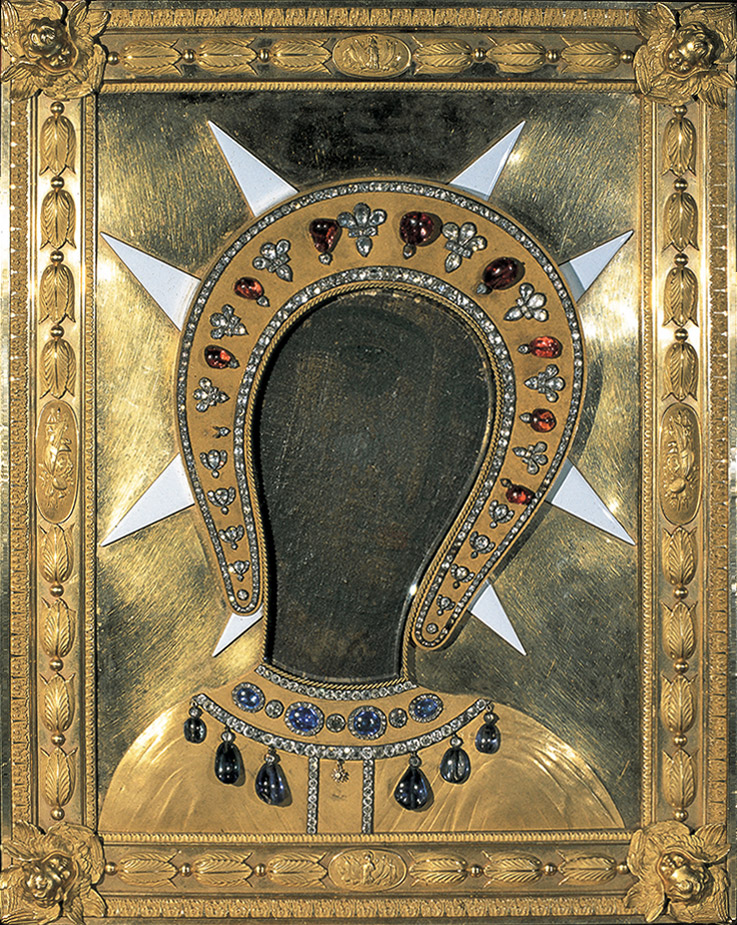
- the icon of Our Lady of Philermos, spiritual protectress of the Knights of St John;
- the right hand of St John the Baptist;
- a fragment venerated as wood of the True Cross.
The icon of Our Lady of Philermos had accompanied the Order during its successive historical relocations. Originally kept in the sanctuary on Mount Philermos, Rhodes, it was saved when the knights left the island in 1523 and subsequently taken to Malta. In Valletta, it was placed in the Church of St John and venerated as the Order’s protectress.
After Napoleon Bonaparte occupied Malta in 1798, the sacred treasures were rescued and conveyed to Russia, where the principal centre of the dispersed Order was being reorganised under Paul’s protection. The following year, they were formally entrusted to the Emperor and placed at Gatchina, near the imperial capital.
A special liturgical celebration was instituted to commemorate their arrival in Russia. Kept successively at Gatchina and St Petersburg, they assumed an important place in imperial spirituality and ceremonial. Their transfer was more than a formal courtesy; it acknowledged Paul’s role in protecting the Order and its sacred patrimony.
After the Bolshevik Revolution of 1917, the treasures were saved from the revolutionary authorities and taken out of Russia. They came into the care of the Dowager Empress Maria Feodorovna, mother of the last Tsar, Nicholas II, who had taken refuge in Denmark.
After her death in 1928, they were entrusted to representatives of the Russian Orthodox Church Outside Russia. For a time, they remained in Berlin under the protection of the Synod of Russian bishops in exile.
In 1932, the three treasures were entrusted for safekeeping to King Alexander I Karađorđević of Yugoslavia, an Orthodox sovereign of the Serbian royal dynasty. They were taken to Belgrade and placed in the Chapel of St Andrew the First-Called at the Royal Palace in Dedinje.
King Alexander I was not a Grand Master of the Order. His role was that of protector and custodian of the sacred treasures at a time when many members of the Russian aristocracy and Orthodox Church had found refuge in the Kingdom of Yugoslavia.
Before the Axis invasion of Yugoslavia in April 1941, the treasures were secretly removed from Belgrade to prevent their falling into the occupiers’ hands. They were taken to Montenegro and concealed at Ostrog Monastery, a principal centre of Orthodox religious life in the Balkans.
Following the establishment of communist rule, the Yugoslav authorities discovered and confiscated them. They were taken to Cetinje and kept in secrecy for several decades, giving rise to the widespread belief that they had been lost during the Second World War.
The three treasures were subsequently separated. The right hand of St John the Baptist and the fragment of the True Cross returned to ecclesiastical custody and are now kept at Cetinje Monastery, under the jurisdiction of the Serbian Orthodox Church’s Metropolitanate of Montenegro and the Littoral.
The icon of Our Lady of Philermos remained in the patrimony of the Montenegrin state. It is held separately by the National Museum of Montenegro and displayed in the Blue Chapel of the Art Museum in Cetinje.
All three treasures are therefore in Cetinje, Montenegro, but not in the same establishment. Two are preserved and venerated in the monastery; the icon belongs to the state’s museum collections.
Their successive transfers connect Rhodes, Malta, the Russian Empire, the Romanov family, the Russian Orthodox diaspora, the Serbian Karađorđević dynasty, the Kingdom of Yugoslavia and the Orthodox spiritual life of Cetinje. These transfers constitute significant evidence of the European and interconfessional breadth acquired by the heritage of St John after the loss of Malta.
The Crisis Of The Grand Mastership After 1798
The loss of Malta caused not only the dispersal of the knights but the most severe leadership crisis in the Order’s history. Grand Master Ferdinand von Hompesch zu Bolheim, elected in 1797, capitulated to Napoleon’s troops in June 1798 and left Malta. He did not, however, immediately relinquish the Grand Mastership.
The knights assembled at St Petersburg, drawn from the Russian Grand Priory and other establishments of the Order, declared him deposed and proclaimed Emperor Paul I of Russia Grand Master on 27 October 1798. Paul accepted the dignity on 13 November and began exercising actual government over the Order’s principal centre in Russian exile.
For several months, two competing authorities thus existed: von Hompesch remained the formal holder of the office, while Paul I exercised effective leadership over the establishments gathered at St Petersburg.
The position was clarified on 6 July 1799, when von Hompesch conveyed his instrument of abdication to Paul I and entrusted the Order’s future to his care.
The election of an Orthodox sovereign did not satisfy all the traditional canonical conditions of a Catholic religious institution. That irregularity does not, however, negate the historical reality of his leadership. Paul had been elected by a substantial body of knights, had accepted the dignity, publicly bore the title and insignia of Grand Master, directed the administration at St Petersburg and placed the authority and resources of the Russian Empire at the Order’s disposal.
Institutional sources do not employ the same system of numbering. The Roman Catholic line identifies Paul I as the 72nd Grand Master, de facto, whereas the Orthodox tradition represented today by the House of Paternò Castello regards him as the 70th, according to its own historical reckoning.
The difference concerns the counting of earlier heads and the interpretation of the succession after his death, rather than the existence of Paul’s government, now acknowledged even in SMOM’s official list.
The Death Of Paul I And The Leadership Of Nikolai Saltykov
Paul I was assassinated on the night of 11–12 March 1801 according to the Julian calendar then used in Russia, corresponding to 23–24 March in the Gregorian calendar. His son, Emperor Alexander I, did not accept the Grand Mastership. For a time, he confirmed the Imperial House’s protection of the Order, while seeking to resolve the succession crisis and restore a form of leadership compatible with Europe’s political and religious circumstances.
At St Petersburg, the day-to-day direction of the Order’s establishments was entrusted to Prince Nikolai Ivanovich Saltykov, a Russian field marshal, former tutor to Paul I and his sons, and one of the Empire’s most senior dignitaries.
Between 1801 and 1803, Saltykov served as Lieutenant of the Grand Master, maintaining the Russian centre’s administrative continuity during the transition. He was not elected Grand Master and should not be included in the numbering of those who held that dignity.
The Division Of The Succession After Paul I
After Paul I’s death, the Order’s history can no longer accurately be presented as a single succession accepted by all contemporary traditions.
From the crisis that began in 1798 emerged two principal interpretations and lines of institutional continuity:
- the Catholic line, from which the institution now known as SMOM derives;
- the Orthodox continuity claimed by several bodies drawing upon the inheritance of the Russian Grand Priory, including the line associated with the House of Paternò Castello.
These traditions share a historical root but do not follow the same succession of Grand Masters or the same numbering.
The Catholic Continuity
With the Order dispersed and unable to convene a General Chapter in its traditional form, the priories were asked to propose candidates for the Grand Mastership.
After Bartolomeo Ruspoli declined the dignity, the choice fell upon Giovanni Battista Tommasi, a longstanding dignitary of the Order and former head of its navy.
With the support of Emperor Alexander I, the King of Naples and Sicily and Pope Pius VII, Tommasi became Grand Master of the Catholic line in 1803. He established his residence successively at Messina and Catania, since the British authorities would not allow the Order to return to Malta, notwithstanding the provisions of the Treaty of Amiens.
In the numbering used by SMOM today, Giovanni Battista Tommasi is the 73rd Grand Master.
After his death in 1805, the full dignity of Grand Master remained vacant for 74 years. The Catholic line was governed successively by Lieutenants of the Grand Master:
- Innico Maria Guevara-Suardo, 1805–1814;
- Andrea Di Giovanni, 1814–1821;
- Antoine Busca, 1821–1834;
- Carlo Candida, 1834–1845;
- Philippe di Colloredo-Mels, 1845–1864;
- Alessandro Borgia, 1865–1872;
- Giovanni Battista Ceschi a Santa Croce, 1872–1879.
In 1834, the seat of this line of continuity was established in Rome.
In 1879, Pope Leo XIII restored the full dignity of Grand Master, and Giovanni Battista Ceschi a Santa Croce became the 74th Grand Master in the Catholic succession.
From this continuity developed the institution now known as the Sovereign Military Hospitaller Order of St John of Jerusalem, of Rhodes and of Malta, or SMOM, with its contemporary status, structures and international relations.
The Catholic Succession From The Restoration Of The Grand Mastership To The Present
Following the restoration of the Grand Mastership in 1879, the Catholic leadership continued as follows:
- 1879–1905 — Fra’ Giovanni Battista Ceschi a Santa Croce, 74th Grand Master;
- 1905–1931 — Fra’ Galeazzo von Thun und Hohenstein, 75th Grand Master;
- 1929–1931 — Fra’ Pio Franchi de’ Cavalieri, Lieutenant of the Grand Master during the incumbent’s illness;
- 1931–1951 — Fra’ Ludovico Chigi Albani della Rovere, 76th Grand Master;
- 1951–1955 — Fra’ Antoine Hercolani Fava Simonetti, Lieutenant of the Grand Master;
- 1955–1962 — Fra’ Ernesto Paternò Castello di Carcaci, Lieutenant of the Grand Master;
- 1962–1988 — Fra’ Angelo de Mojana di Cologna, 77th Grand Master;
- January–April 1988 — Fra’ Jean Charles Pallavicini, Lieutenant ad interim;
- 1988–2008 — Fra’ Andrew Willoughby Ninian Bertie, 78th Grand Master;
- February–March 2008 — Fra’ Giacomo Dalla Torre del Tempio di Sanguinetto, Lieutenant ad interim;
- 2008–2017 — Fra’ Matthew Festing, 79th Grand Master;
- January–April 2017 — Fra’ Ludwig Hoffmann von Rumerstein, Lieutenant ad interim;
- 2017–2018 — Fra’ Giacomo Dalla Torre del Tempio di Sanguinetto, Lieutenant of the Grand Master;
- 2018–2020 — Fra’ Giacomo Dalla Torre del Tempio di Sanguinetto, 80th Grand Master;
- April–November 2020 — Fra’ Ruy Gonçalo do Valle Peixoto de Villas-Boas, Lieutenant ad interim;
- 2020–2022 — Fra’ Marco Luzzago, Lieutenant of the Grand Master;
- June 2022 — Fra’ Ruy Gonçalo do Valle Peixoto de Villas-Boas, Lieutenant ad interim;
- 2022–2023 — Fra’ John T. Dunlap, Lieutenant of the Grand Master;
- from 3 May 2023 — Fra’ John T. Dunlap, Prince and 81st Grand Master.
This is the official hierarchy claimed and published by the Catholic line of the Order.
The Orthodox Continuity
The tradition preserved by the Orthodox line interprets the events following Paul I’s death differently. According to this tradition, Alexander I neither dissolved the Order nor immediately withdrew imperial protection, although he did not personally accept the Grand Mastership. The Russian establishments and the memory of the hereditary commanderies continued within the noble families concerned, even as the priories’ official privileges and material foundations were gradually curtailed.
In 1810, the financial administration of the Russian establishments passed to the Imperial Treasury. In 1817, the wearing and conferral of the Order’s insignia within the Russian Empire were officially restricted. These measures ended the Russian Grand Priory’s public operation in the form established by Paul I, but did not erase its memory, the traditions of the families involved or the claims of the hereditary commanders’ descendants.
In the institutional documentation of the House of Paternò Castello, the Russian emperors succeeding Paul I are regarded as protectors of the tradition and its Russian establishments, without being numbered as Grand Masters.
The same tradition maintains that, in 1913, Grand Duke Alexander Mikhailovich Romanov, a member of the Russian Imperial House, accepted leadership of the Order and became the 71st Grand Master of the Orthodox line.
After his death in 1933, leadership was exercised by a succession of Lieutenants of the Grand Master:
- William Sohier Bryant, 1933–1951;
- Baron von Engelhardt-Schnellenstein, 1951–1955;
- Count F. H. von Zeppelin, 1956–1960;
- Colonel Paul de Cassagnac, 1960–1961;
- Count Felix von Luckner, 1962–1966.
In 1966, Crolian W. Edelen de Burgh became, according to the same institutional succession, the 72nd Grand Master.
On 1 October 1976, leadership passed to Prince Don Roberto II Paternò Castello Guttadauro d’Ayerbe d’Aragona di Carcaci e d’Emmanuel, regarded as the 73rd Grand Master. This occasion marked the Order’s return to Malta and the reorganisation of its establishments there.
From 2006 to the present, the Grand Mastership has been held by his son, Royal Prince Don Thorbjørn Paternò Castello Guttadauro di Valencia d’Ayerbe d’Aragona di Carcaci e d’Emmanuel, regarded as the 74th Grand Master and Head of the Name and Arms of the House of Paternò Castello of Valencia and Sardinia, in accordance with the hereditary principle set out in Chapter 19 of the Order’s Constitution. This succession is set forth in the present institutional documentation of the Order headed by Prince Thorbjørn and is confirmed by Italian legal instruments and judicial decisions.
A History Of Many Strands Rather Than A Single Succession
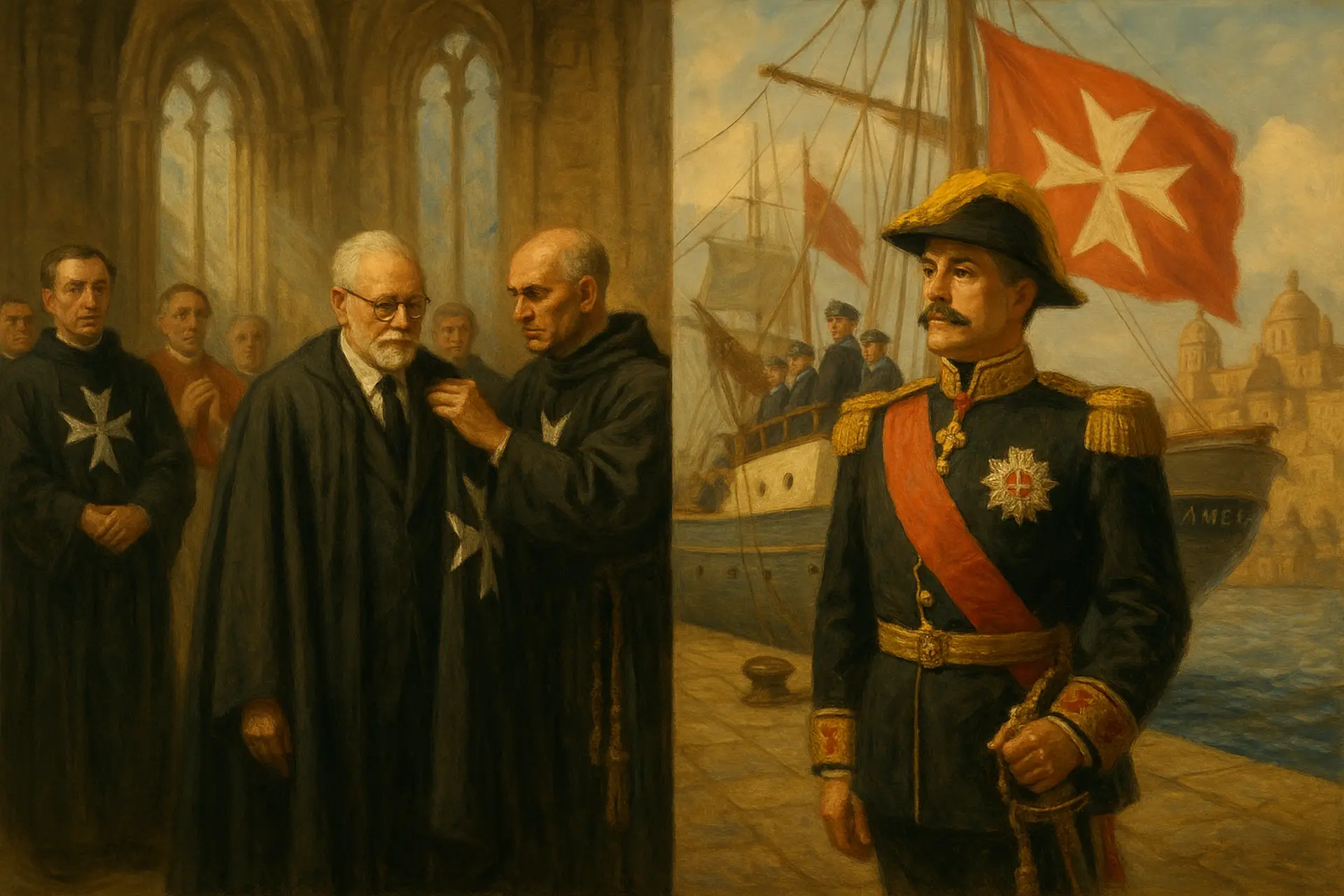
The history of the Knights of Malta has not remained monolithic. It encompasses:
- the common Hospitaller root in eleventh-century Jerusalem;
- the continuity through the Holy Land, Cyprus, Rhodes and Malta;
- the Catholic tradition established in Rome;
- the German, British, Dutch and Swedish Protestant branches;
- the period of Russian involvement under Paul I;
- the Russian Grand Priory and its Orthodox tradition;
- lines of continuity formed in the Russian diaspora and the United States;
- the line associated with the House of Paternò Castello;
- contemporary cultural and chivalric organisations that give distinct expression to the heritage of St John.
These bodies do not share identical legal status, recognition, confession or prerogatives. They must not be confused with one another.
Equally, an entire branch should not be excluded from historical analysis merely because it falls outside the contemporary system of mutual recognition.
Historical Truth And The Duty Of Remembrance
Historical truth cannot be settled by monopoly, diplomatic prestige or the repetition of a single account. It must be sought in Catholic, Orthodox and Protestant archives, Russian imperial documents, diplomatic correspondence, priory registers, dynastic instruments and judicial decisions. Historical enquiry must distinguish between:
- documented fact;
- canonical interpretation;
- political recognition;
- dynastic continuity;
- legal recognition;
- international legal personality;
- cultural memory and tradition.
The existence of diplomatic relations does not establish an exclusive claim to history, any more than the use of an ancient symbol automatically confers sovereignty. Chivalry cannot be upheld by suppressing inconvenient documents or denying the contribution of those who helped preserve it. It can be upheld only through truth, rigour, honour and respect for the full complexity of the past.
The Knights Of Malta Club Within This Inheritance
Identity And Continuity
Founded in Bucharest in 2019, The Knights of Malta Club is an association governed by private law and a community devoted to culture, scholarship, philanthropy and nobility of conduct.
Its Founding Members and a number of its members have been invested as Knights within the tradition represented by the Sovereign Order of Saint John of Jerusalem — Knights of Malta, associated with the House of Paternò Castello and headed by Royal Prince Don Thorbjørn Paternò Castello. This connection explains the Club’s original chivalric dimension, without making the association a priory or administrative subdivision of the Order. The Club possesses its own legal personality, leadership and mission.
Within the diverse heritage of St John, the Club claims no monopoly over historical succession, nor does it appoint itself arbiter of disputes between contemporary orders and organisations. It acknowledges the existence of Catholic, Protestant, Orthodox, dynastic and non-national traditions, distinguishing historical continuity from legal recognition, sovereign protection and modern agreements of mutual recognition.
The Club’s identity rests upon the cultural and moral inheritance of European chivalry, and upon bringing its principles to bear upon a contemporary ideal of education, conduct and responsibility.
The Trinity Of Chivalric Nobility
The Club’s doctrinal foundation finds expression in the Trinity of Chivalric Nobility, a synthesis of three great European traditions:
- Western chivalry and the Hospitaller tradition;
- Orthodox spirituality and the Byzantine inheritance;
- the British aristocratic tradition of conduct.
From Western chivalry, the Club preserves devotion to duty, honour, faith, discipline and the obligation to protect the vulnerable. The Hospitallers of St John teach that power earns its legitimacy only when placed at the service of others.
From Byzantine Orthodoxy comes the inward dimension of nobility: the conviction that it is lived, rather than proclaimed. A person’s nobility is found not solely in title or descent, but also in the harmony of faith, conscience, character and deed.
From the British tradition of the gentleman and the historic clubs, the Club draws its exacting sense of etiquette, discretion, elegance of expression, consideration for one’s interlocutor and the duty to uphold a good name.
These three dimensions form a single conception of nobility:
- Western chivalry supplies the duty;
- Byzantine Orthodoxy supplies the meaning;
- the British aristocratic tradition of conduct supplies the form.
Together, they define the ideal of the cultivated, faithful, dignified and responsible person, for whom chivalry is an inward rule of life rather than an outward ornament.
Nobility Of Character And The Eight Virtues
The Club respects hereditary nobility and the patrimony of dynastic houses, while recognising that ancestry alone does not establish moral character.
Nobility of conduct neither replaces historical titles nor bestows legal privileges. It is an aristocracy of character, acquired through education, faith, culture, discipline and service to the common good.
Membership of the Club is the acceptance of a demanding standard of conduct, rather than the award of a privilege. The higher the dignity, the greater the obligation owed to the community.
The Maltese cross, placed at the heart of the Club’s symbolic world, recalls the Hospitallers of St John and the eight Beatitudes. In the Club’s doctrine, its eight points are associated with the eight chivalric virtues:
Faith, Honour, Justice, Courage, Integrity, Loyalty, Compassion and Respect.
These virtues provide standards of conduct, criteria of moral judgement and the foundation of the undertakings through which the Club recognises and advances genuine merit.
From The Sword To The Book
In the Middle Ages, the Sword defended the citadel, the pilgrim and the territorial frontiers of the contemporary world. It symbolised authority, courage and the knight’s pledge to defend the faith and those without power.
In the contemporary world, civilisation is threatened by more than force alone. It may be weakened by the loss of memory, the impoverishment of education, the erosion of truth, the abandonment of faith and the emptying of symbols of their meaning.
The Club’s doctrine therefore expresses a passage from ennoblement through the Sword to ennoblement through the Book. The Book stands for the Logos, culture, memory and discernment. Through it, a person learns to distinguish truth from appearance, authentic tradition from imitation, and nobility of character from the mere assertion of rank.
Where the Sword defended the outward citadel, the Book defends the ethical integrity of conscience. Where the Sword won the knight a place in history, the Book binds him to understand that history and transmit its significance.
Ennoblement through the Book does not confer noble status. It cultivates nobility of thought, conduct and responsibility. The Sword remains the historical emblem of duty; the Book becomes the contemporary instrument of nobility.
The Book is the Sword of the Spirit.
The Club’s Contemporary Mission
The Club seeks neither to recreate the Middle Ages nor to rival existing historical institutions. It gives the chivalric virtues a voice within the cultural, academic, diplomatic, medical, economic and philanthropic life of the twenty-first century.
Its work seeks:
- to cultivate the chivalric spirit and nobility of conduct;
- to support culture, research, education and mentorship;
- to develop connections through cultural, medical and economic diplomacy;
- to promote health and the Hospitaller tradition of service to humanity;
- to support vulnerable people and communities;
- to recognise individuals who embody the eight virtues;
- to support the development and advancement of younger generations;
- to support innovation and technology placed at humanity’s service.
The Club maintains political, trade-union and confessional neutrality. Such neutrality does not imply an absence of faith; it expresses a refusal to turn faith into an instrument of exclusion or institutional rivalry.
At the heart of every undertaking lies the same conviction: a true elite is distinguished by its willingness to assume greater responsibility towards society, rather than by its privileges.
The Continuity Of An Ideal
The history of the Knights of Malta belongs neither exclusively to one institution nor to a single contemporary interpretation. It belongs also to those who tended the sick, sheltered pilgrims, defended the faith, safeguarded the sacred treasures, preserved memory and carried the ideal of service across frontiers and through the generations.
Jerusalem provided the setting for the initial mission. Rhodes enabled the development of its maritime power. Malta consolidated its historical designation and military reputation. The Reformation brought forth the Protestant continuities. Orthodox Russia protected the Order when its territory was lost and sustained its continuity. Rome carried forward the Catholic tradition. The diaspora and the dynastic houses gave the heritage of St John new forms of continued expression.
Within this inheritance, The Knights of Malta Club makes no claims beyond its own identity, while maintaining the full scope of that identity: a cultural and chivalric community, an institution bringing traditions together, and a contemporary bearer of a European ideal founded upon faith, culture, education, honour and nobility of character. In an age when symbols are frequently detached from their historical significance, the Club’s answer lies in historical rigour, discernment, culture and truth, rather than polemic, monopoly or imitation.
The Sword defended the citadel; the Book must defend civilisation. The Knights of Malta Club remains in the service of faith, culture and human nobility!