
There are epochs in which civilisations do not cease to exist, but merely cease to recognise themselves. They do not collapse in spectacle; they fade, slowly, losing not so much their institutions as their essence; not their territories, but their criteria; not their forms, but the memory of the meaning that once gave those forms life. In such times, nobility is reduced to appearance, education to the simple accumulation of information, and faith to rhetorical ornament. Everything that once constituted the backbone of European existence is gradually treated as a museum artefact—admired, yet devoid of living function. And yet, truth does not perish; it does not vanish, but withdraws, awaiting the one who will recognise it anew.
From this consciousness of meaning in retreat, and from the need to restore criterion, The Knights of Malta Club , was born, founded in 2019 in Bucharest, at a historic point of confluence between East and West. The Club is not a formal reproduction of a medieval order, nor a nostalgic genealogical claim, but an institution of synthesis, meant to reactivate those structures of the European spirit that for centuries guaranteed order, dignity, and the continuity of civilisation. Its aim is not to preserve the past as relic, but to continue it as a living principle, gathering a community of those who understand nobility as an inner virtue and a public responsibility.
The philosophical and identitarian foundation of The Knights of Malta Club rests upon a Trinitarian conception of Chivalric Nobility, in which duty, meaning, and form are interwoven into a single nature. This Trinity is not a mere juxtaposition of traditions, but an organic synthesis, in which each dimension finds fulfilment only through the others: the Western chivalric tradition of duty, the Byzantine tradition of interior meaning, and the British aristocratic tradition of form.
From Western chivalry, heir to both effervescent Catholicism and the ethos of the Hospitallers of Saint John of Jerusalem, the Club preserves the solemnity of devotion in the service of mankind, the discipline of sacrifice in the name of faith, and the conviction that honour is a duty. The Knights of Malta were warriors, healers, and diplomats alike—defenders not only of earthly frontiers, but of the frontiers of the soul. They did not merely fight; they served by living their faith. Their austere and magnificent creed—Pro Fide, Pro Utilitate Hominum !—constituted a moral anthropology in which the worth of a man was measured not by circumstance, but by the architecture of his conduct, wherein faith, charity, and personal discipline formed an indestructible unity.
From Byzantine Orthodoxy, the Club inherits the metaphysical dimension of identity: the conviction that nobility is not proclaimed, but lived; not an external title, but a quality of the inner temple. Byzantium understood that the truest battle is not always at the walls of a city, but within the interior citadel of the soul. To be noble meant to be ontologically grounded, in harmony with the Logos. The Christian knight was not a mere feudal functionary, but a phylax—a guardian of memory, divine order, and cultural continuity. To live nobly meant to be noble, and this conception—rooted in discipline, liturgy, and righteous living—survived long after empires had burned, remaining as a spark beneath the ashes of history.
From the British behavioural aristocracy—shaped by Protestant and Anglican traditions, moulded in the culture of the gentleman and the refined milieu of elite London clubs—the Club adopts the rigour of etiquette, the elegance of tone, the sobriety of gesture, and the cult of discretion. In those rarefied spaces, the word became currency, conversation a craft, reputation a fortress, and refinement a discipline of character. It was there understood that elegance without integrity is vanity, and power without manners is barbarism. Though not chivalric orders, those clubs preserved the essence of chivalry: grandeur must be cultivated in private before it manifests in public. As Edmund Burke observed, “manners are of more importance than laws.” This tradition upheld that nobility without form degrades itself, and power without style descends into barbarous despotism.
These three traditions do not coexist in The Knights of Malta Club as parallel strands, but form a living unity, akin to three hypostases of one principle. Western duty without Eastern meaning would become mechanical and devoid of light; spirituality without the rigour of form risks dissolving into abstraction; British form without the other two would remain impeccable yet sterile. Together, they restore the human being to a wholeness that modernity has fragmented without ever replacing.
At the heart of the Club’s doctrine lies a symbolic transfiguration that distinguishes it decisively within the contemporary landscape: the passage from ennoblement by the Sword to ennoblement by the Book. In the Middle Ages, the sword was the instrument of consecration. The ritual of knighthood marked the passage from the common to the exceptional. The sword separated, selected, imposed order, and guarded the visible boundaries of the world. It was the symbol of authority, legitimate force, and commitment unto sacrifice. The Book becomes the sword transfigured by light. It marks not an external rank, but an interior awakening. If the sword separated the soldier from the multitude, the Book separates spirit from imitation. The sword made the knight visible in history; the Book renders him necessary in eternity. The sword conferred status; the Book confers conscience. Ennoblement through the Book affirms that true aristocracy is acquired not only by descent, but by ascent—not only by what one inherits, but by what one dares to become.
Under the emblem of the Maltese Cross—symbol of the eight beatitudes and of the four cardinal virtues of Honour, Justice, Faith, and Courage—the Club grounds its identity in the historical heritage of the Knights Hospitaller. The White Cross, worn for centuries as a sign of faith and devotion, becomes for the members of the Club a moral point of orientation, a call to balance, honour, and responsibility in an age that frequently forgets such values. In this context, the sword becomes insufficient. It may conquer territories, but it cannot order consciences. Thus, The Knights of Malta Club has enacted a profound doctrinal shift: the Book has become the Sword of the Spirit. The Book symbolises the Logos, discernment, memory, and the capacity to distinguish truth from simulacrum. If the sword conferred rank, the Book confers bearing—forming conscience. Education is therefore not an accessory of nobility, but its highest form. As Saint Basil the Great wrote, “an uneducated mind is a city without walls.” Ennoblement through the Book testifies that aristocracy is no longer mere genealogy, but genesis: an ongoing birth through culture, faith, and character. The sword remains as historic symbol of duty, but the Book becomes the contemporary instrument of selection. This is the profound significance of the Club: the transformation of medieval chivalry into the etiquette of modern thought.
Belonging to the Club signifies the recognition of chivalric qualities refined through education into a nobility of thought and manners characteristic of the modern gentleman. The members—drawn from diplomatic, academic, cultural, economic, and entrepreneurial spheres—are united by shared principles and criteria, which they validate through every undertaking, conscious of the fact that The Knights of Malta Club operates as a private-law association, maintaining absolute neutrality in political, syndical, and confessional matters. In a world that measures value through visibility and possession, the Club measures it through conduct, culture, and discretion. It is not a refuge of the past, but a form of active continuity. It does not recreate medieval knights; it forms individuals capable of bearing chivalry within themselves as an interior law. Nobility is no longer imposed by the sword, but assumed through the Book. Through its work, the Club promotes culture as an expression of nobility, education as the foundation of the future, and philanthropy and honesty as moral duties of those called to lead by example. At the core of its philosophy lies the conviction that the true strength of an elite resides not in privilege, but in its capacity to assume responsibility for the continuity of values.
Thus, The Knights of Malta Club is not a showcase of the past, but a school for the future—one that does not revive what once was, but restores what must be: an aristocracy of character rather than mere lineage; of purpose rather than privilege; of continuity rather than nostalgia. In a world where institutions falter and identities dissolve, the Club asserts itself discreetly yet firmly as a fundamental truth: civilisation is not upheld by impersonal structures, but by guardians of meaning. These guardians are not appointed; they recognise each other, bearing the mission of forming men worthy of chivalry, capable of carrying nobility as an inner law. In this sense, The Knights of Malta Club does not merely preserve a heritage; it prepares those who will carry it forward, as expressed in the Club’s motto:
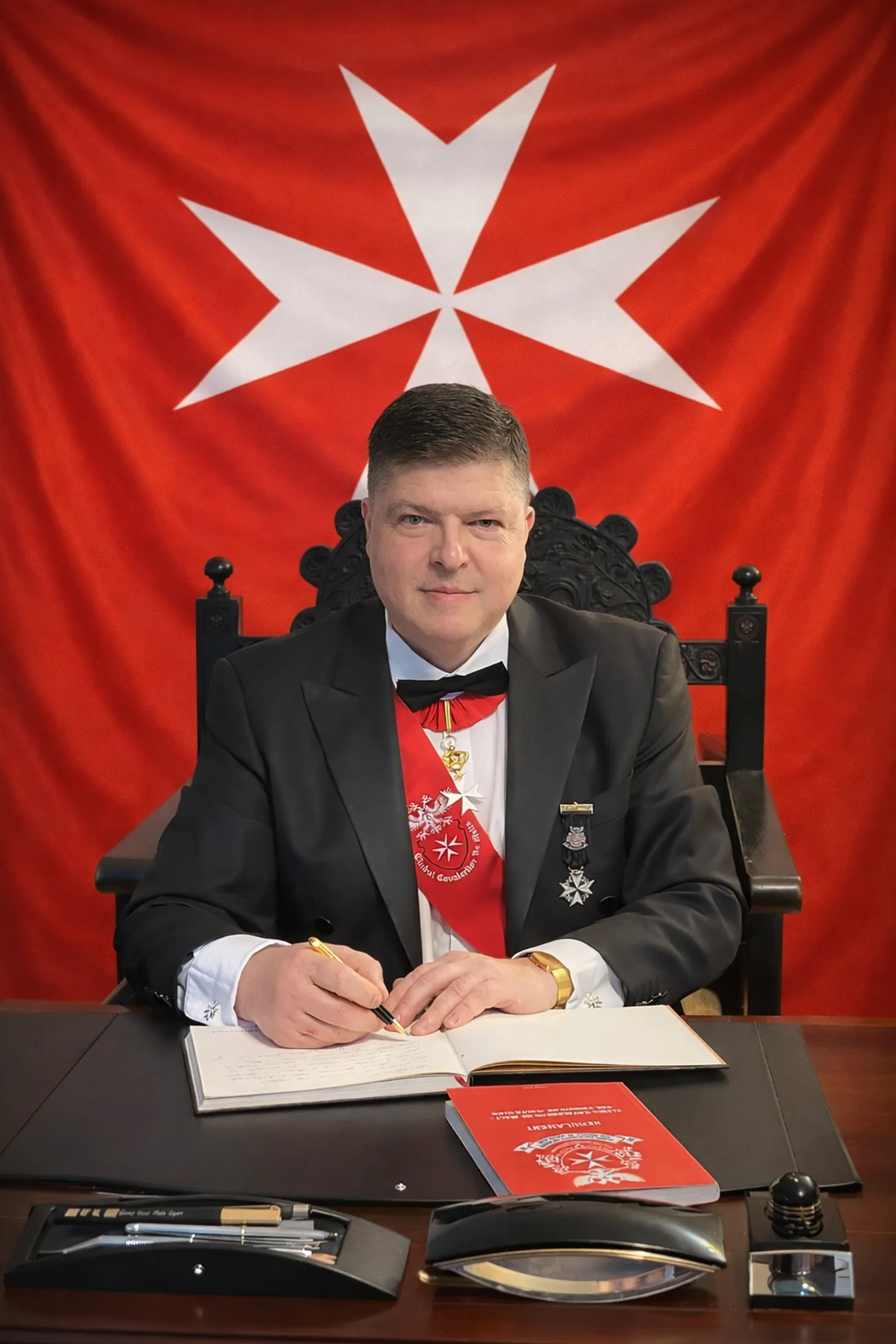
HENK Dr. George-Costin RUSU
Chairman – Grand Master
of
THE KNIGHTS OF MALTA CLUB
In the service of faith, culture, and human nobility!